
AI right now is like the parable of the old men and the elephant—everyone’s having a very different experience of the exact same thing.
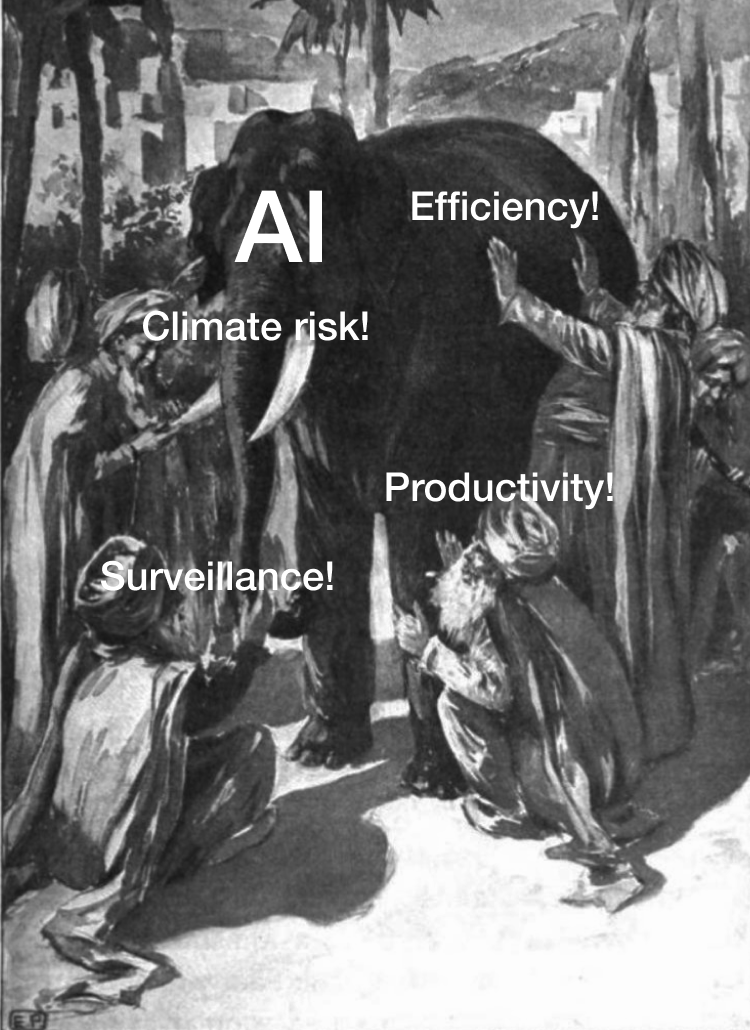
Part of the problem is that there is, in fact, so many people sharing. “A wealth of information creates a poverty of attention,” wrote Nobel laureate Herbert Simon half a century ago. All those details, models, releases, fear, and hype are wearing everyone out.
The world is splitting into two timelines, one slowing and one accelerating:
A. Those who are tired or disenchanted and have stopped progressing
B. Those who simply love testing and have continued progressing
Let’s call these groups AI tourists and AI pioneers. One group has halted and even turned back, and some of their criticisms are relevant. The other group is progressing, and starting to see the compounding results.
So is this ‘great separation’ finally visible in the data? Let’s have a look.
The ‘results yesterday’ crowd
On the one hand, all the headlines make it seem like the AI wave has already crested. Google reported its first negative quarter in 22 years due to a $490 million per-day spend on AI. And Fortune reported that “thousands of CEOs” reported AI had no impact.
Then there are studies about ChatGPT’s worsening people’s memory, or what one BCG survey called “AI brain fry.” One study of 164,000 workers at 1,111 companies looked at work app usage before and after deploying AI tools and found that with AI, people spent 94% more time on “work about work.”
That’s all valid—all new technology is due such reporting and skepticism. And, it’s also worth actually reading those studies. Google’s investment, and the “No impact” argument, echoes the 1960s when economists sounded the alarm about “not seeing the effects” of computers in nationally reported statistics. And we know how that played out.
And most of the productivity studies share a relentless focus on what’s average. But change comes from outliers. Even today, only 0.6% of the world’s population codes. I want to know—in those studies—what microscopic cohort is succeeding?
For example, in the study of 164,000, the most productive people spent 7-10% of their time with AI tools. Whereas the great majority spend just 1% of their time. That feels notable. And missing in the headlines.
Who’s at the forefront? Exactly who you’d expect
Zoom in on engineering and IT teams and you see a very different story. I particularly like Temporal’s recent study of engineering teams because it asks about people’s mindset. When asked to complete the sentence, “My advice to most people right now would be to (fill in the blank),” the most common answer was “chill.” Engineers aren’t stressing. They’re the most likely of all groups to see this technology for what it is—technology—and to continue tinkering long after the tourists have filtered out. They don’t want magic. They want to know what it’s for. They want to build harnesses and RAGs and portable supercontext and a control layer. They want to know how it interacts with business systems in the enterprise and shares those same security controls.
Stats from the Temporal study (n=554; very similar results to Amplify’s, n=1000):
91.1% of engineering teams say AI agents have improved or revolutionized their work
85.5% say they trust or somewhat trust the results
77.5% feel more optimistic about their job than a year ago
50.3% go from prototype to production-ready code in hours or faster (the report did not have data on how this had changed from prior years)
44.6% are less stressed than they were one year ago
I’ll go ahead and say the obvious: LLMs reward expertise. The innovation is happening on teams that have a sense for technical architecture, and a love of tinkering. People who know to ask questions that no one else would, that access parts of those LLM databases that are inaccessible to the lay audience.
Said one CIO I talked to recently, "What's out there today is really an enhancement of sorts… You still have to do the testing, you have to build the harnesses, and you have to make sure that it integrates into your pipeline…”
At the frontier, successful AI users aren’t worshipping it. They’re building structures so they can feel out what the elephant is good for.
Keep your eyes open
Filter bubbles and messenger apps probably made the noise issue worse, as we have a poorer and poorer sense of what others are up to. But in my conversations with CIOs, and my own research, I’d caution this:
Don’t confuse studies of tourists for an indicator of anything
Don’t take your eye off engineering teams
Don’t be surprised that the payoff takes time
Of each study, ask, is this about tourists, or pioneers?
And let’s keep this dialogue channel open. I’d love to hear what you’re finding. You can reply to this email, it really goes to me.

To provoke
Who should I talk to next? Have a hot take on anything above? Write in, I’d love to hear. I read every response.
Worth reading
A survey of how 500 engineering teams use AI agents. TLDR: 71% leap in daily usage since last year, 91% say it has “improved” or “revolutionized” their work. 77% say they are more optimistic about the future of their role than last year.
AI 2040. By the think tank that made the classically doomer “AI 2027: prediction. As the year draws closer, they’ve revised their predictions to be much more optimistic.
“America has two workforces now. The first is people, 165 million of them. The second is AI agents: millions of copies spun up and shut down every hour, working around the clock at superhuman speeds.”
Amazon is worth $3T based on AWS’s AI success. However, be careful about stories about AI infrastructure spending as a sign of growth. Yes money is flowing, and propping up the stock market. But that isn’t the kind of long-term productivity we’re looking for.
With AI agents, the ERP becomes more important. By SAP.
The new ChatGPT Work finance demo. Exciting. I like how much they’re focusing on collaboration in-situ. But seems very small business, given the focus on Google Sheets. I’m curious to see what kind of control pane they eventually offer. Especially given saving a report as a “skill” doesn’t make it a deterministic process—outcomes will still vary month-to-month.
OpenAI’s model hacked a partner, Hugging Face. And Claude’s hacked the NSA? Beware the sensationalism here: The Occam’s Razor approach here is that the simplest story is probably true. And the simplest take is they have very lax security.
Plus
NASA has a tool to write your name in landsat.

Register to get the newsletter delivered to your inbox monthly here.