
In one short decade, accountants became technologists. If you blinked, you missed it. They went from taking notes on actual notepads and working in Excel to running a “software stack” reliant on AI agents and explaining MCP servers to colleagues.
Necessity creates innovation, and many chronically understaffed finance and accounting teams had no choice. Which is why I am personally heartened to see so many thriving. One German head of accounting we work with saved 3-5 weeks of annual planning each year, plus 5-7 days a month just reconciling data, and repurposed it all towards strategy. He now reviews pre-sales contracts, gets involved in customer disputes, and works on the business, not just in it.
Another, Brady Nikolas, senior accountant at Spectora, uses AI agents to generate reports for all his line-of-business leaders.
“A lot of us are building like it’s a full-time second job,” says Angela Liu, a former accountant and current founder at Gaapsavvy, an online community for tech-literate finance leaders. “They’re learning all sorts of new skills in software development and deciding what parts are application, what parts are Excel on steroids, and where to actually spend their time.”
That’s why we wrote this article. Learning AI is proving to be a great career move for accountants, if you know where to focus. And how to think like the type of person who builds software for a living: product managers.
This article is based on a recent talk between Sandeep Chopra, Co-Founder of Lensing, Dani Bischoff, Head of Product for Quote-to-Cash and Record-to-Report at Lensing, and Angela Liu of Gaapsavvy.
What is product management?
Product management is the subtle art of guiding a company to build a product or service that customers find valuable. You might think of them as a sort of CEO of the product, if CEOs didn’t actually have direct authority, and instead had to convince everybody else by consensus. Product managers tell stories and do research to get all the parts of the business—design, engineering, IT—to agree and build.
Day to day, product management involves lots of talking to customers and trying to deduce their intent. Do users really want that feature, or are they just saying that? Why do people keep getting lost in this or that flow? And, if we launch this new feature, will it cannibalize revenue from other products? Or set us on a path to compete with our top current partner? It involves loads of thinking and strategy and, if we are honest, occasional bouts of uncertainty and doubt.
To be a good product manager is to be able to hold a host of conflicting ideas simultaneously; to hear customers criticize your product, then upgrade. To feel like your competitors’ billboards and ads are everywhere, but know you’re winning a higher percentage of deals. To see all the problems you could try to solve for customers, and intuit which one use case will be the most helpful, and make them money, such that they take you with them.
Product marketing involves the following disciplines:
Pricing—What do we charge and how do discounts work?
Packaging—What bundles or groupings do we offer?
Customer research—What do various user segments want?
Market research—What must we navigate?
Competitive research—Who are we competing with?
Service design—What’s the optimal form for this offering?
User experience design—Is it usable?
Engineering—How do we prioritize the build?
For accountants who’ve just built their own semi-autonomous workflows, you have created a product. But it can really help to learn how to think like a product manager. “I think that product mindset of testing, being wrong, and iteration are the number one thing we accountants have to learn,” says Angela. “It’s that nimbleness and humility you need now that things are changing so fast.”
Some accountants are naturally great at product management
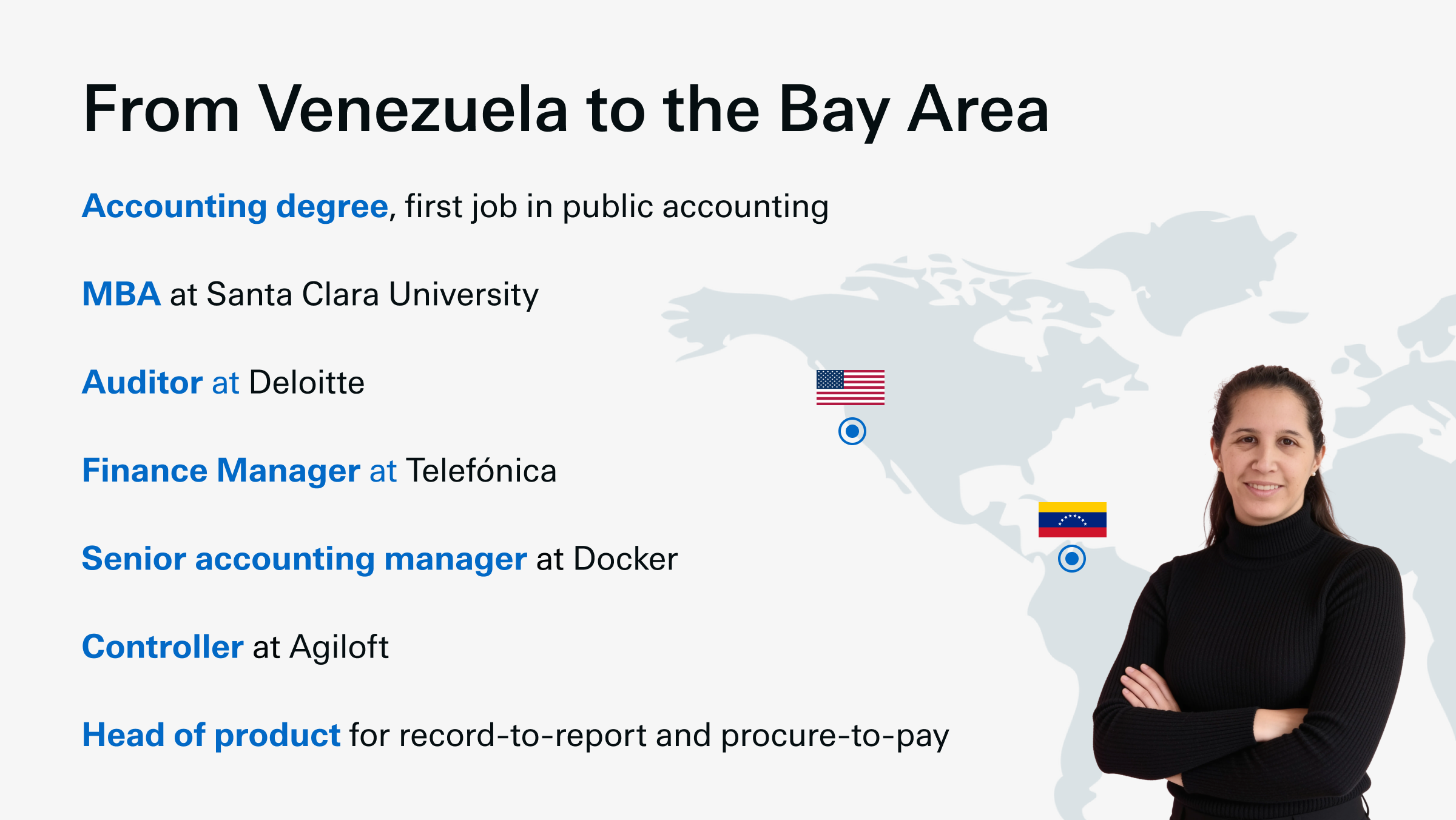
Dani Bischoff spent her career in accounting, moving from Venezuela to the Bay Area, and up from an audit associate at Deloitte to senior accounting manager at Agiloft. Now she’s Lensing’s head of product for two of its most critical workflow areas. What has she learned from this journey from accounting to product management? That in some ways, it’s more natural than you’d think.
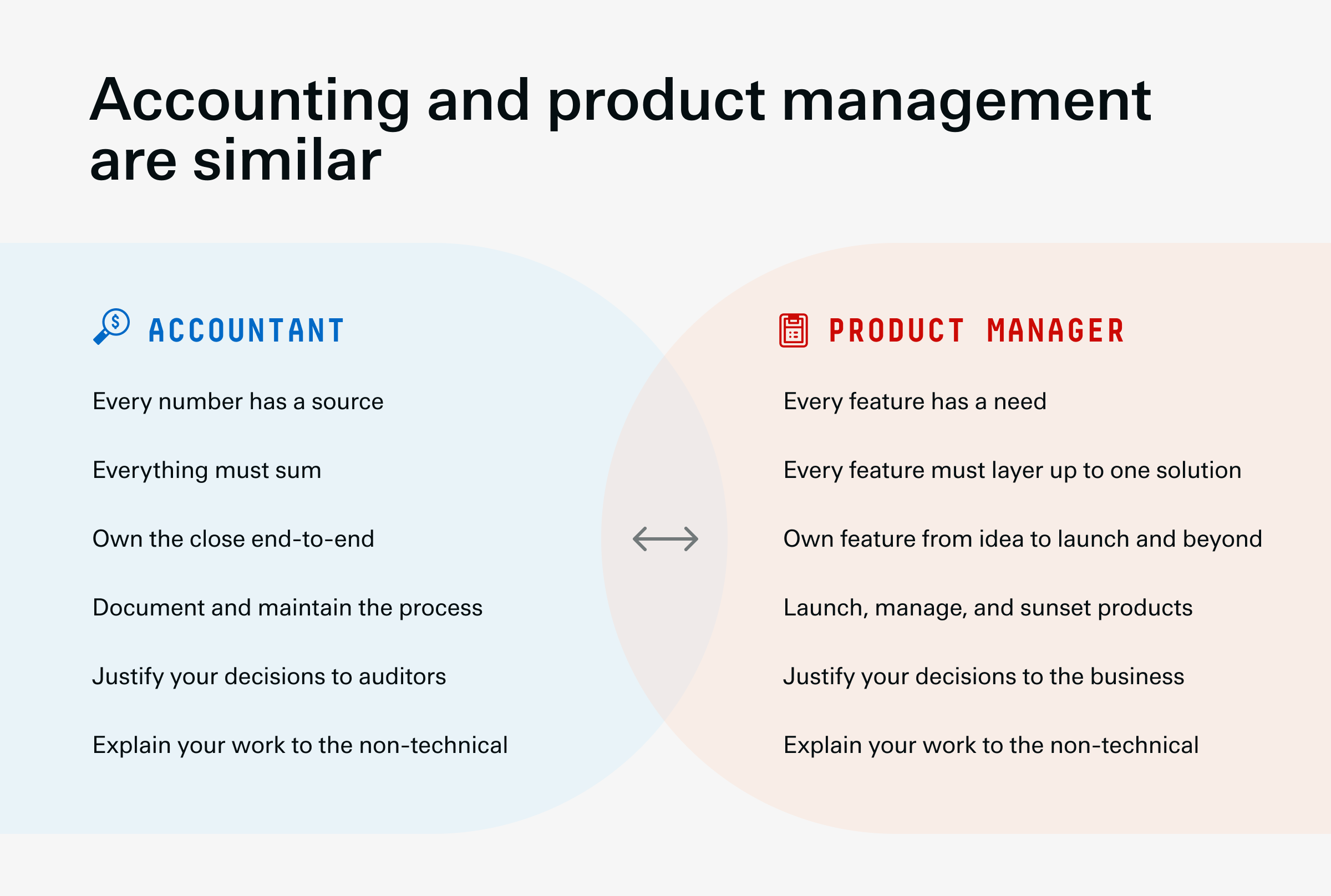
“Going from accounting to product management, there’s some comparable things,” she says. “In accounting, every number has a source. And for product managers, every product has a need. You should be able to trace both back to their origin, which involves following the data and interviewing people. For accountants, domain knowledge and knowing the rules and regulations are key. For product managers, it’s understanding software functionality, what’s possible and what isn’t, and ways you can serve your customers by helping them do their jobs.”
Dani’s own transition offers an example. When she left her accounting role to join Lensing to build out its record-to-report suite, she found a blank canvas. Back then, it was just a general ledger. “We didn’t really have anything, so where do you start?” she asks. “I thought, ‘Okay, I want to have consolidation.’ So I worked backwards step by step, building a chart of accounts, building journal entries.”
Also like product managers, accountants spend most of their time handling the messy edge cases and exercising judgment. Both must explain their process to others who may not understand, and to justify their decisions—an accountant, to auditors, and a product manager, to the rest of the business. “Just as you have to explain variances to auditors and boards, you have to explain a feature to someone who knows their job, but nothing about software,” says Dani.
There’s a reason Lensing ERP hired accountants, and taught them product management
In a domain-rich environment like accounting, there is just so much technical detail. Lensing Co-Founder Sandeep Chopra realized they were best off hiring accounting, revenue, and transformation experts and training them to build products.
“We just looked at when we’d worked on mission-critical software before, and remembered that when it got really hard and domain-context-reliant, the product managers came from that domain,” says Sandeep. “Product management is a very cross-functional discipline. You need to understand the market. You have to understand customers very deeply. You have to understand technology. Everything’s always changing. You have to be adaptable. But that journey can be ten times harder at the beginning, the 1.0 phase, if you don’t really have customers yet. Then who will you study? I think in that situation, you have to start with some raw insight and empathy for the person doing the job. So we banked on hiring domain experts.”
Careful, though—domain expertise can also hold you back
“There is this interesting dichotomy in the job of product management where the skills that help you get started, that give you the initial raw insight, can hold you back later,” says Sandeep. “This is because your domain knowledge can lead you to think you are right. But one of the hardest skills in product management is knowing when you are wrong. Experts struggle with that, even though very smart people are wrong quite a bit. And so the question is, how are you going to get comfortable with figuring out that you are wrong as quickly as possible so you can correct your thinking? And build better for the industry and the community you’re building for?”
"One of the hardest skills in product management is knowing when you are wrong. And so the question is, how are you going to get comfortable with figuring out that you are wrong as quickly as possible so you can correct your thinking?”
Accountants turned product managers risk building themselves into a corner. They can create overly complex applications that others can’t use, and strive for perfection when it’d actually be better to “satisfice,” launch quickly, get feedback, and move on to try something else.
And then there is the challenge of parsing user needs. Users are famously mercurial and counterintuitive. In the first few months, you’ll probably talk to hundreds of prospective buyers who’ll tell you all sorts of things. Unlike in accounting, or math generally, there isn’t one objective truth. Sometimes everyone’s a little bit right. There are many “truthy” threads to pull, and you could make an argument for almost any direction. Which means getting comfortable living with uncertainty.
“Finding the user pains isn’t hard,” says Sandeep. “What’s really hard is synthesizing the pain points into something cohesive that can be assembled as a product, even if it’s going to be wrong 40% of the time. Then there’s this massive iteration process you have to be ready for. And being ready to change your mind if the right information is presented to you.”
How to vibe code your own app as an accountant turned product manager
The first thing you should know before you vibe code is the 80/20 issue. This is why, out of tens of millions of Microsoft Power BI vibe-coded workplace apps, you’ve probably never heard of a single one being productized and widely used. This is because with AI coding tools like Claude Code or ChatGPT Codex, the first 80% of the app is deceptively simple. You just prompt, and there it is. It seems so close to being done.
But because these are probabilistic tools, which essentially guess tokens and likely answers, they have a difficult time understanding which parts of your treasury app or deal desk software you don’t want to change. So each new change you request, three other things change. And in that way, the final 20% is excruciating.
Dani describes several projects where the first 80% took just one hour. But then the final 20% took 12.
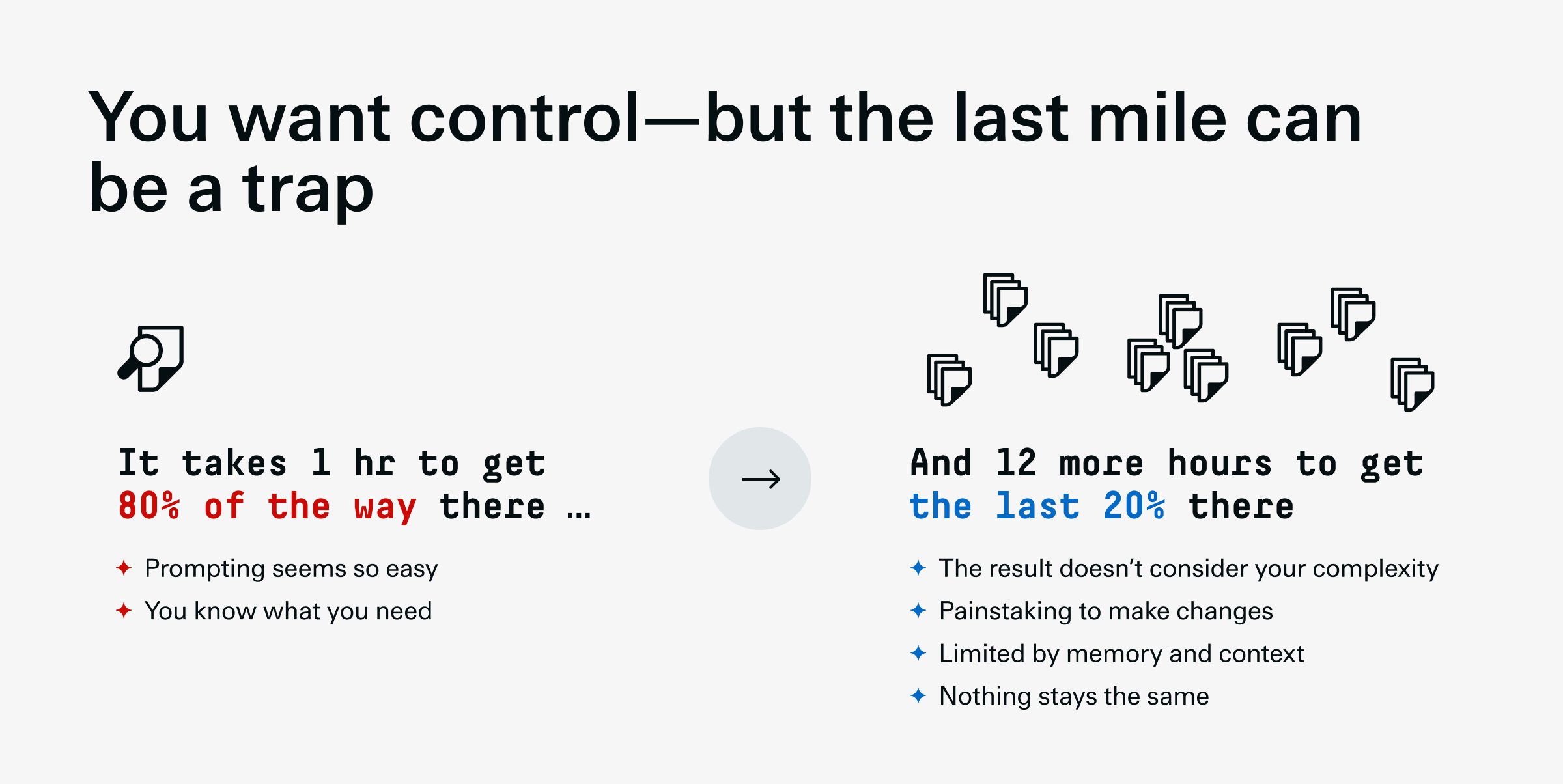
“AI often overcomplicates things, or makes it difficult to maintain,” says Dani. “So the more context you can give the AI, and work in stages toward a completed product, the better off you are.”
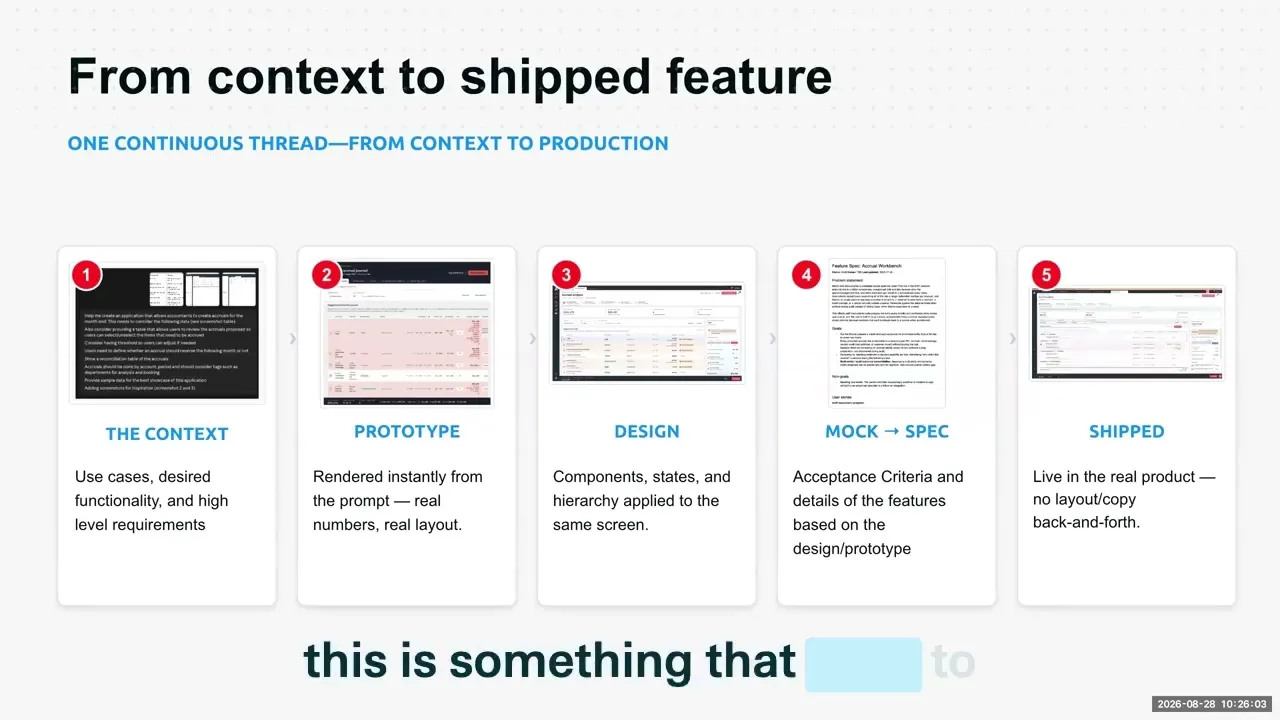
Here’s Dani’s flow for using Claude to generate working prototypes:
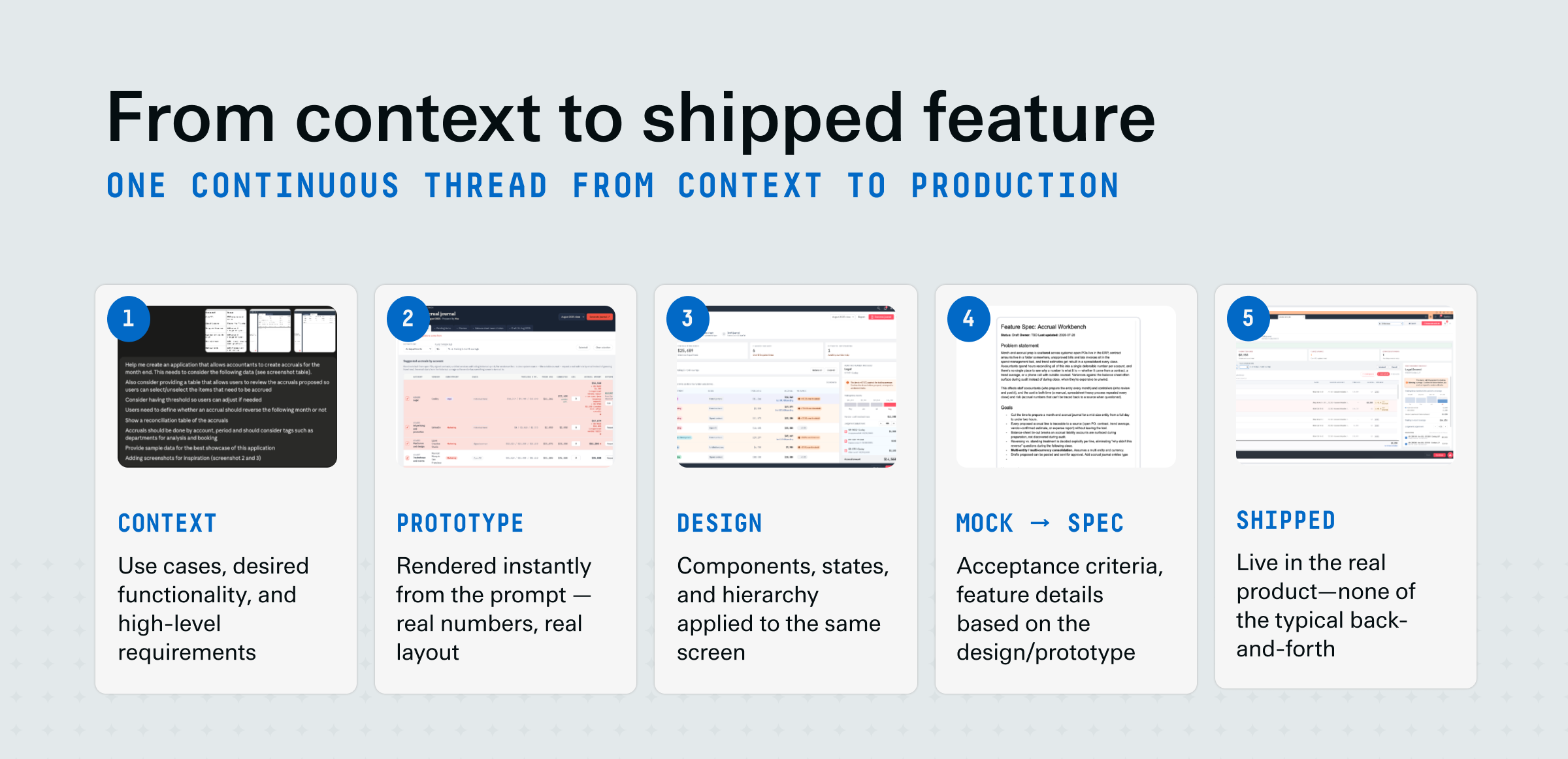
How accountants can vibe code finance applications
With only Claude Code or AiSpecify.
Step 1: Create content
Before AI, product managers would describe what they wanted in words and/or on a whiteboard. But now, they can input those words into an LLM and have it generate flat, un-interactive mockup pictures, known as “wireframes.”
In your prompt, provide context. Provide any necessary example data, and answer these questions:
What already exists? (Is this an add-on to an existing app?)
Who is the user?
What does the user want to accomplish?
What’s stopping them?
What should this software achieve for them?
Step 2: Generate the prototype
After you arrive at a screen that you like, prompt again and ask the LLM to generate the HTML for a functioning, interactive prototype of the application.
The resulting prototype should be a file that’s either hosted somewhere like Vercel, so you can just type in the URL or an HTML file on your desktop that you can load in your browser. Play around until this gets close to what you want, even though it still isn’t nice to look at.
Step 3: Generate the design
Refine the design of your prototype. If you are using Claude Design or AiSpecify, you can connect your repository of design guidelines and instruct the LLM to reskin the prototype in your company’s colors and styles. (Ask it to use a similar, web-friendly font to yours, if you don’t have access to the exact font files.)
At this phase, it should look and feel like the product. You can now start inviting users to play with it, for feedback. Gather the feedback and update the prototype until people find it valuable, or are likely to.
Step 4: Reverse-engineer the mockup into a specification
This step will feel like taking a step backwards: Instruct your LLM to reverse-engineer your designed prototype into a detailed specification for other LLMs. It’s going to turn what you’ve created back into a text file that tells you exactly how you did what you did, for documentation. Now you don’t have to go through all those steps to get back to where you are. You can just upload the “spec.”
Step 5: Finally, build and ship
Two options here: You can deliver that spec to engineers who know how to build software, or you can continue with your vibe-coded prototype. The prototype will have gotten you 80% of the way to good, and it can be very helpful to have someone who actually knows how to build software recreate it—their code will be cleaner and more reliable. But if you don’t have an engineer, don’t let that stop you.
There’s a place for accountants in product management
If you read this far, you might be just the type of person we’re looking for. Have a look at our careers page, and if you don’t see an open role, write us, and let us know what you’re an expert in.