Hawk switches to Lensing ERP, saves 10 weeks a year



Industry
Fraud detection software
Size
170 employees
Locations
Germany, U.S., Singapore, UK
Complexities
German local accounting, multiple entities, international business
Replaced
QuickBooks Online, Xero, DATEV
Rhett’s team was spending all their time on manual reconciliation
Rhett Short was hired to solve a problem: Hawk needed to consolidate its financials globally, or the fragmentation would eventually block their growth. “A core target for me coming in as head of accounting was to find a new ERP and get us off the old systems,” says Rhett, “and to modernize our internal accounting processes. Upon my arrival, we were drowning in consolidation work. The accounting team was spending a majority of their time just reconciling the differences between systems. It was a massive drain on capacity.”
The accounting team was spending a majority of their time just reconciling the differences between systems. It was a massive drain on capacity.
In this arrangement, Rhett, as head of accounting, had to manage most of the accounting work. Another full-time employee spent all their time preparing reports for management or on aging accounts receivables. “One-and-a-half headcount was dedicated to just compiling information,” says Rhett, “and reporting alone took 5-7 working days each month.”
“We never had the ability to consolidate across all entities monthly, or even quarterly,” he says. “We only completed a year-end consolidated close for audit purposes, and that took us 3-5 weeks. It was a big effort.”
Part of the challenge was that their four entities in Germany, the U.S., the UK, and Singapore were running their own ledgers, and they didn’t match. A single transaction might be recorded differently across systems. The more Hawk grew, the worse it got.
“Some systems wouldn’t let us tag by department or cost area,” says Rhett. “As a result, we couldn’t see what was a cost center, track spend on print media, or see direct customer-related costs.”
Hawk’s primary office is in Germany, and that created a complex value-added tax (VAT) situation across all entities. Each had nuances in local reporting and compliance. “In Germany, we have a statutorily defined chart of accounts and strict benefits policies around medical aid contributions, pension contributions, church taxes, employee considerations, and more,” he says.
“A lot of finance people will say, ‘Well, that’s just how it is,’” says Rhett. But he was unwilling to settle. It was time for Hawk to graduate to an ERP. And he wouldn’t purchase one from the larger software incumbents if he could help it. “I knew the older ERP systems would require a massive services spend, which for a smaller company like us, was not really viable.”
So Rhett started searching for a newer, mid-size ERP.
Rhett was determined not to get locked into an older system
At a prior company, Rhett had implemented SAP S/4 HANA. “I was already aware of the changing ERP landscape, and I knew off the bat that one of the legacy systems wasn’t going to cut it. But neither was one of the smaller, off-the-shelf ERP providers,” he says. “I didn’t want to buy a big one and get locked in. But we also had complexity and needed to customize.” He wondered if they should just skip the valuation and go with NetSuite. But recent stories about Oracle gave him pause.
Rhett started searching with AI to build a list, which ended up including NetSuite. “For due diligence, we didn’t rule it out,” he says.
Rhett’s requirements:
-
The strongest core accounting
-
German localized knowledge (HGB)
-
Consolidation around a German core entity
-
Multi-book and multi-entity accounting
-
A user-friendly interface for accountants
-
Automation for bonuses and payroll
-
VAT reporting, with full customization
-
Intercompany eliminations
-
Foreign exchange transformations
-
Dimensional tagging
“Intuitiveness was very important to us,” says Rhett. “Does the system do the accounting in a way that is understandable? Can we book journals easily enough? What does the process look like when it comes to amortization? How do depreciation schedules run?”
After conversations with the major vendors, Rhett decided Lensing offered the strongest core accounting platform, in addition to the best AI approach. “From our perspective, Lensing had the core accounting module for us,” says Rhett. “I felt like the other newer entrants were very flashy. They had all this unique stuff. But their foundational accounting function wasn’t there. Especially when considering our local German requirements, only Lensing already knew what we had to do.”
Further, Lensing’s team stood out as experts trying to help solve a problem. “From what I could tell in all the demos and discussions, Lensing was full of qualified CPAs,” says Rhett. “They could speak to the content from the perspective of an accountant. They helped me feel comfortable that their core accounting could handle our roll-up, consolidated reporting, and VAT use cases.”
“Lensing was full of qualified CPAs. They could speak to the content from the perspective of an accountant.”
Plus, the fact that Lensing’s development headquarters is in Heidelberg was a big help. “We knew we wouldn’t be at the mercy of time differences, and we just got a good feeling from all the people we spoke to prior to signature,” says Rhett. “I felt they had the requisite German knowledge. Whereas the other providers would have struggled to read a German chart of accounts.”
And while Lensing had the strongest AI story, it didn’t feel forced upon Hawk. “I think AI is obviously influential, and we’re seeing improvements and new use cases every day,” says Rhett. “But I think if you ask most accountants, that’s not what moves the needle. Perhaps for some very small companies. But if the computer is generating an output, we need to be able to stand by our bookings. We need our financials to be auditable and immutable. You can’t have only a computer doing that. Which is why core accounting mattered more.”
Lensing, they felt, was much more mature, in both product offering and team.
“Lensing are real experts,” says Rhett. “The fact that most people we talked to there were accountants made it much easier. They understood our issues fundamentally. When you talk to a salesperson that doesn’t know accounting, it’s very clear. But at Lensing, from Cameron all the way down, people were registered CPAs. That made a big difference.”
“Lensing was much more mature, in both their product offering and their team. Lensing are real experts.”
Lensing helped them consolidate all 4 ledgers
As the migration started, Rhett realized it would be more involved than he expected. And that was good. The Lensing team helped them identify ways they needed to organize their accounting processes and data, and also customize the implementation to Hawk.
“At every stage, they were very open about what the platform could and could not do,” says Rhett. “I don’t think I’ve encountered someone at Lensing who flat out said, ‘No, that’s not possible.’ They worked tirelessly with us on small adaptations and changes and getting our integration to our spend management system working really smoothly. They were always willing to support.”
As a result, Hawk’s accounting team now has one ERP system covering all four global entities, including one deprecated entity, from which they can draw data for historical comparisons. “What we have today with Lensing as a provider, and what we had previously, are worlds apart,” says Rhett. “The whole team here is very happy with our choice of platform and the performance.”
“What we have today with Lensing as a provider, and what we had previously, are worlds apart. The whole team here is very happy with our choice of platform and the performance.”
Hawk has now deployed Lensing for:
-
Record-to-report with one global view
-
Multi-entity financial consolidation and reporting
-
Native multi-book for local standards (HGB, US GAAP, SFRS) as well as global standards (IFRS)
-
Avalara integration for local VAT filing (e.g., UStVA, EC-Listing)
-
Payhawk integration for spend and expense transactions
-
AI agents such as the bank transaction match agent
-
Professional services automation (PSA)
With lensing, Hawk now has:
German HGB books with consolidated reporting across 4 entities
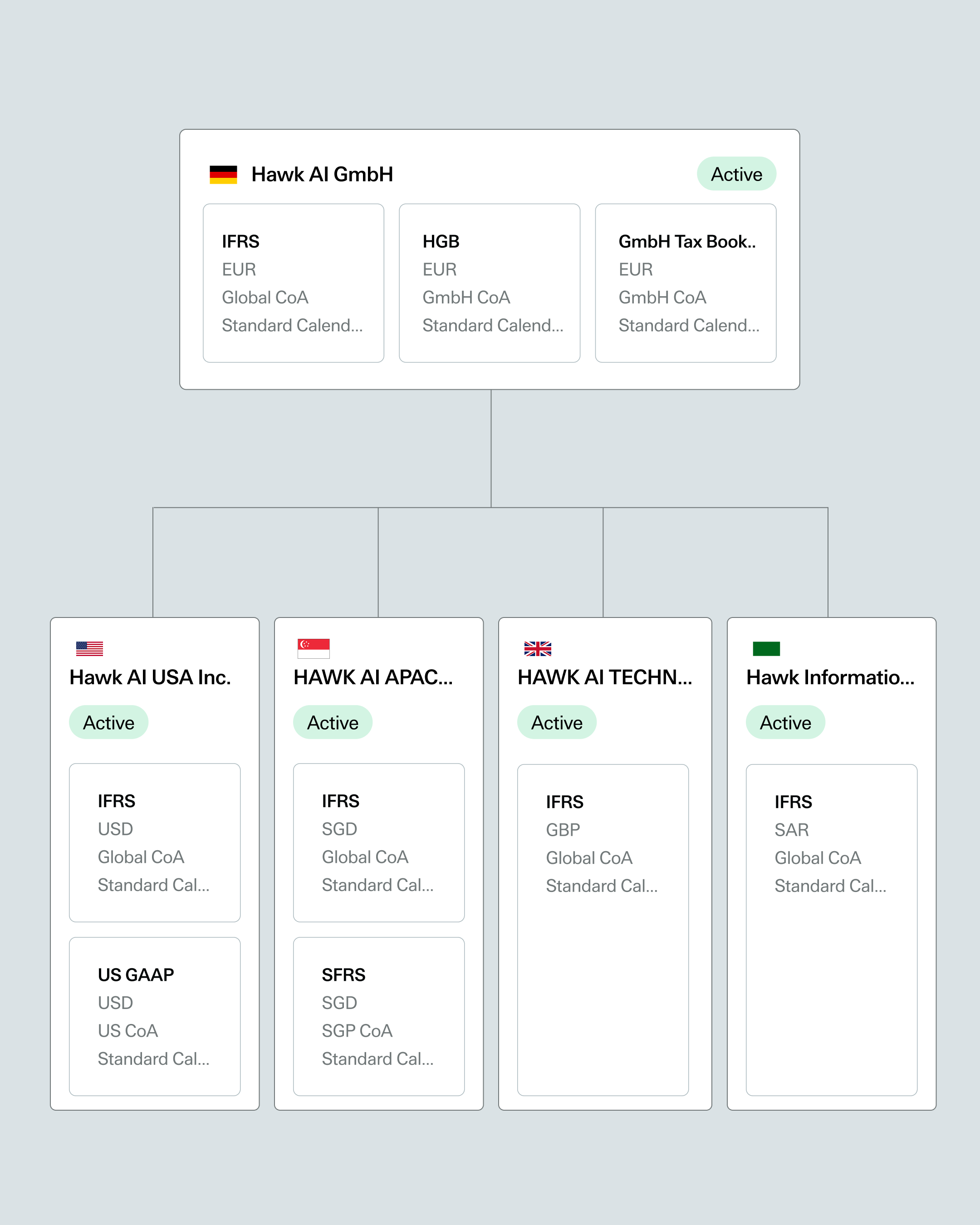
They run their full German business with German standards under HGB, while still having consolidation under IFRS. This eliminates all the time they used to spend consolidating the prior four systems, and adjusting entries in Excel to move transactions from the local standard to the IFRS standard.
“We consolidate fully across all entities and jurisdictions, as well as multiple ledgers. Each entity has a local ledger with a local chart of accounts, as well as a global IFRS standard chart of accounts,” says Rhett. “That rolls up to a consolidated group view. This is a massive improvement for us. I couldn’t have imagined we’d be able to do that in a system.”
"We consolidate fully across all entities and jurisdictions, as well as multiple ledgers. Each entity has a local ledger with a local chart of accounts, as well as a global IFRS standard chart of accounts. That rolls up to a consolidated group view. This is a massive improvement for us. I couldn’t have imagined we’d be able to do that in a system.”
Automatic intercompany transfers, exchanges, and translations
Their new multi-book, multi-entity setup handles all translations and adjustments for them:
-
Currency conversions
-
Intercompany eliminations
-
IFRS adjustments
“Prior, this was a massive lift on our end,” says Rhett.
Monthly reporting and organized closes
“Now we are reporting monthly out of our system. We have a management report that splits across multiple dimensions, which has been a massive time savings,” says Rhett.
Standardized data and dimensional tagging
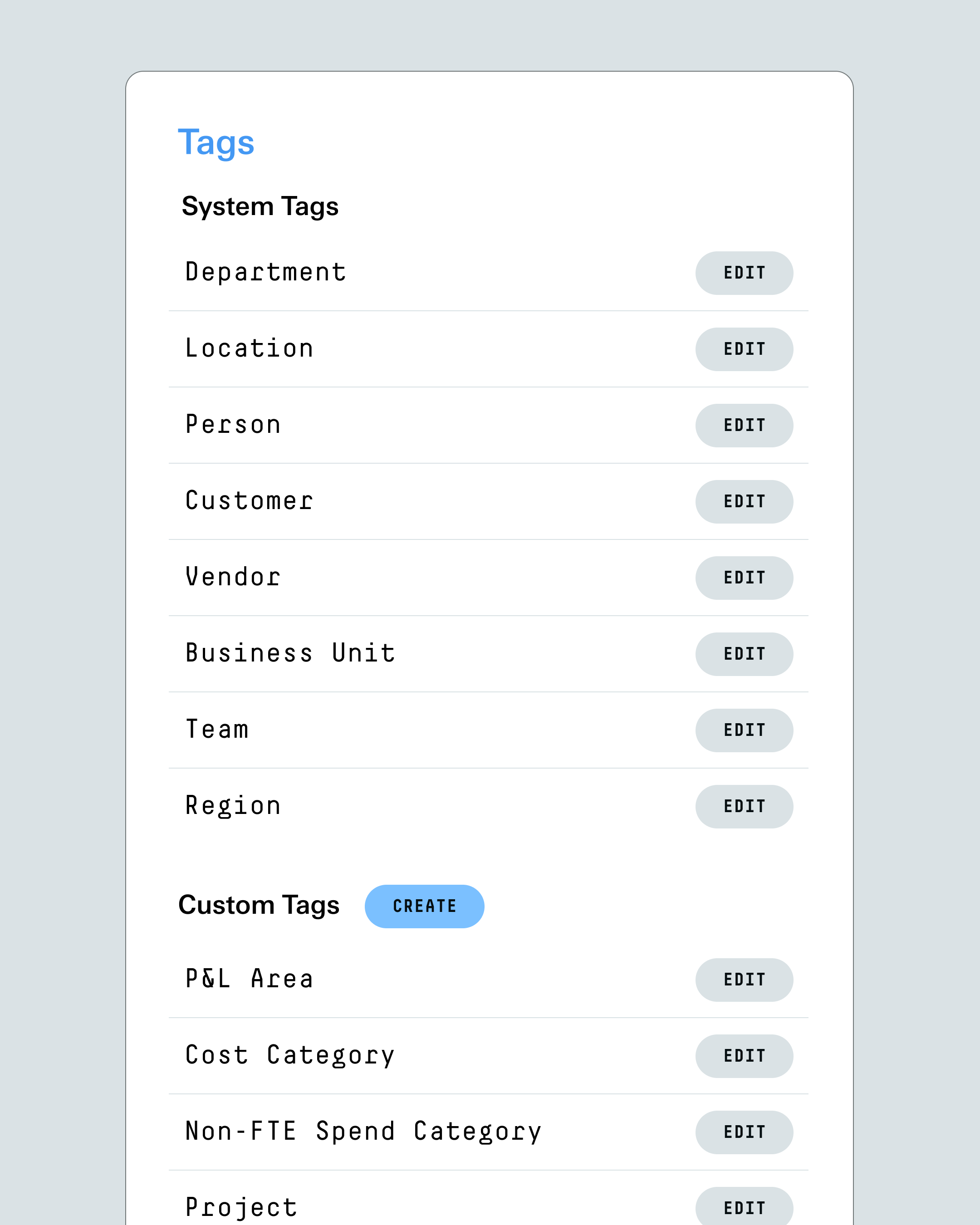
Now that all four entities are in one ERP, Rhett and team have standardized their data and tagging across all. “It’s consistent across all systems, and because of dimensional tagging, we can add multiple dimensions that aid in decision-making,” says Rhett. “We can tag by market segment, budget owner, cost center, department, full-time employee versus non-full-time employee, and P&L area.” Rhett and team can use that information to improve reporting and look at the data on different levels than they were ever able to see before. And since implementation, they have added new, additional custom tags on their own. “This is also a very big improvement,” says Rhett.
VAT reporting improvements
Hawk also now has transactions in Lensing that include VAT codes. Those codes and transactions then pass to Avalara through a native integration, which handles the filings. “I only know of one other ERP that does this, and it’s NetSuite, and it comes at a very significant cost,” says Rhett.
Agents
While AI wasn’t Rhett’s primary purpose in migrating, it was still important. His team needs every advantage. Lensing agents help them match banking transactions. In the future, his team is excited to launch more agents. Lensing also gives them a foundation to use AI tools at three levels, both natively and through an MCP server:
-
Chat with Lensing in natural language
-
Use agents to complete accounting work
-
Use AI tools to customize Lensing and build internal apps
With Lensing, Rhett’s role has become more strategic
All the days and weeks of Excel time have now vanished. Rhett finds that it means he can be more of a participant in the business, helping on strategy and improving processes.
“We used to spend many days a month on core accounting and required statutory processes just to keep the business running,” says Rhett. “Now I can focus on work that improves overall business operations, like contract reviews, supporting sales on customer disputes, and rethinking our processes every month. That alone has driven improvements in other areas.”
Next up, Rhett plans to continue to build out Lensing. They are looking into standardizing their highly varied contracts using Lensing’s quote-to-cash, adding more new entities, and building custom cash flow reports.
“Lensing really goes far beyond accounting. We’re starting to extend it into other areas of the business like the product,” says Rhett. Specifically, they plan to integrate Lensing into Databricks, where Hawk stores its customer data, for a full 360-degree view of the customer.
“The more we use Lensing, the more we see new ways we can use the capabilities of the platform, and get even more out of it,” he says.