


At 29,032 feet above sea level, Everest’s peak is among the most formidable climbing projects a person can ever undertake.
Not everyone who climbs Everest will summit. To do so, you need supreme confidence in your training, stamina, gear, and most of all, your team. For all those reasons, Everest was a great code name for our project to reimagine the ERP for the AI era, competing against some of the largest software companies with 40-50-year head starts and hundreds of billions in market share.
Now we can leave that name behind as a plaque. Customers have selected it to run their core financial operations with combined revenues exceeding $1 billion across 20 countries. We are proud of the years of quiet, confident work that went into building a complete ERP.
Now we can turn our gaze up to what’s next—which is why we can reveal the business’ true name, “Lensing.” It suggests our customers won’t just summit mountains, but can aim much, much higher.

Why the name Lensing?
Lensing is pronounced “lens-ing,” because it’s about lenses. It’s when massive objects align so precisely that the light around them bends and is drawn into focus—revealing what was always there but previously out of reach.
It’s an astrophysics term: Gravitational Lensing is when a cluster of galaxies exerts such immense gravitational weight that together, they bend all the light toward them. To us here on earth, that bent light forms a ring. Within that ring, you can see a magnified view of galaxies that are much, much further away. It’s a giant magnifying glass in the sky.

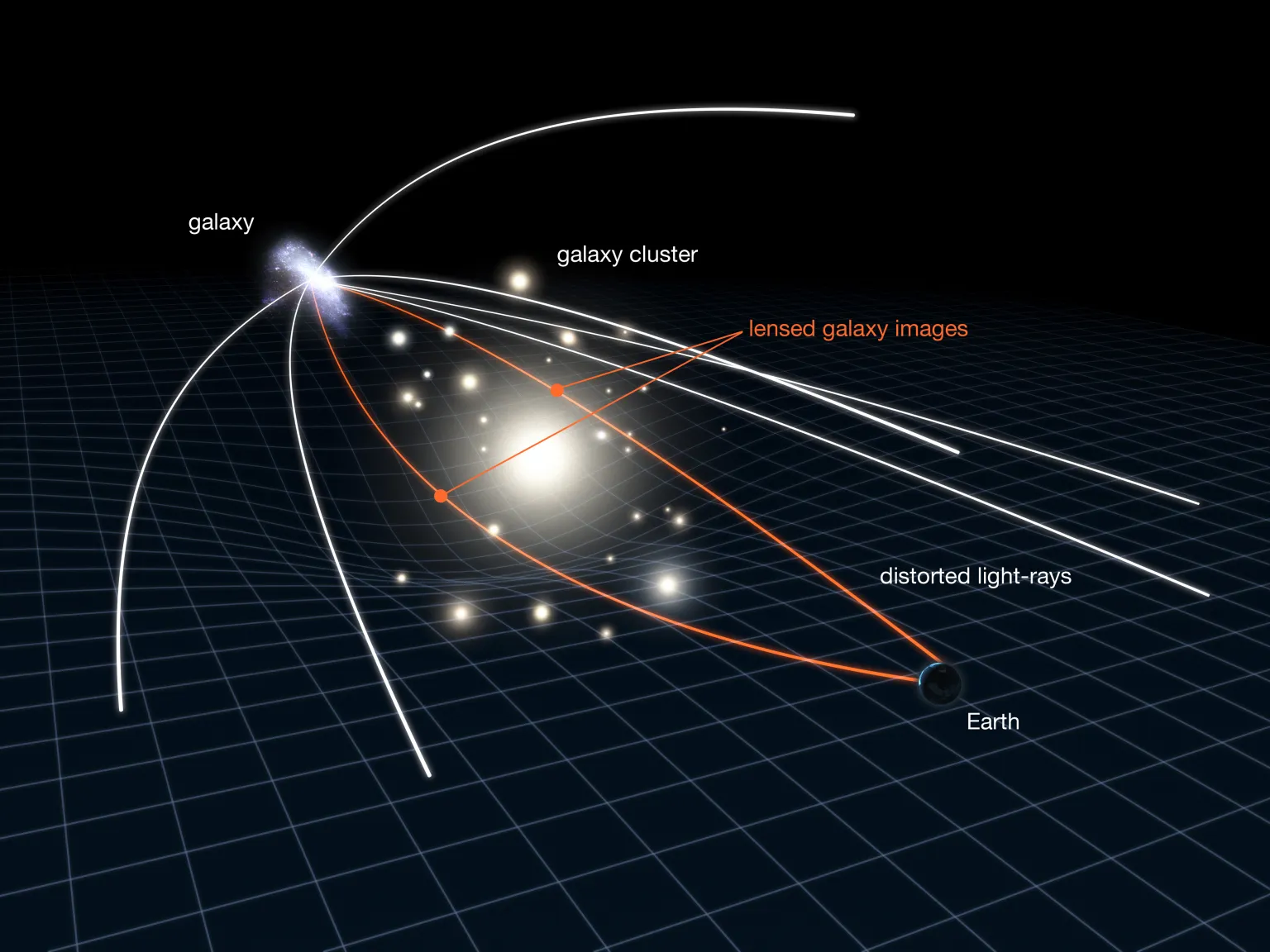
For astronomers and scientists, lensing is a convenient miracle. It’s like building a space telescope with a lens the size of the sun, then saying, “This is too small” and stretching it trillions of miles wider to cover the entire Milky Way. And having millions of those lenses scattered throughout the sky, all beaming information from galaxies that are hundreds of billions of lightyears further away.
It’s a lot to wrap your head around, and a great analogy for the work we do.
ERP is the largest, most complex class of software and trying to understand all the sprawling details of a global enterprise’s ERP implementation can feel like navigating a star system. It takes real audacity to propose switching ERPs, even if you don’t like yours, because of the countless workflows, auditing, security concerns, internal resistance, and change management. Few who attempt to swap ERPs succeed.
Yet our system, Lensing, is powerful enough to reliably accomplish it. One customer that spent two years trying to launch NetSuite got Lensing up and running in under three months. Lensing can draw all those large and dense internal objects into perfect alignment—to reveal unimaginable new clarity.
We know that this seems hard to believe. But that’s part of the name’s history, too. Albert Einstein discovered it. When he first announced his theory of relativity, the scientific world ridiculed him. But he proposed a test—if gravity worked the way he thought, stars should lens. Astronomers tested it on our own sun and realized he was right. So there’s a bit of a “challenging the heterodoxy of the day” aspect to our name, too. We see ourselves in the footsteps of those innovators, and we welcome the skepticism. Come see a demo.
And speaking of challenging long-held beliefs, it really is time, isn’t it? Because five years into the “AI revolution” companies are realizing that you do not simply bolt-on generative intelligence to your core financial systems and expect results. To make real use of this foundational new technology, you need to realign some very massive objects that haven’t changed in 50 years.
This time, with AI, it’s different
We believe that AI is a fundamentally different technology. Even with the present backlash, it is woefully undervalued. LLMs are the first technology to reduce the volume of task work. Think about any other software prior—all were reliant on humans to input the information and push it to the next workflow stage. Software companies sold “automation,” but it was decidedly manual.
For the first time, technology can complete the work. That is exciting—and midsized and enterprise businesses are casting about for ways to apply it. And they’re finding their most foundational software systems, their ERPs, are not up to the task.
Today the world is stuck with one of two types of ERP-like system:
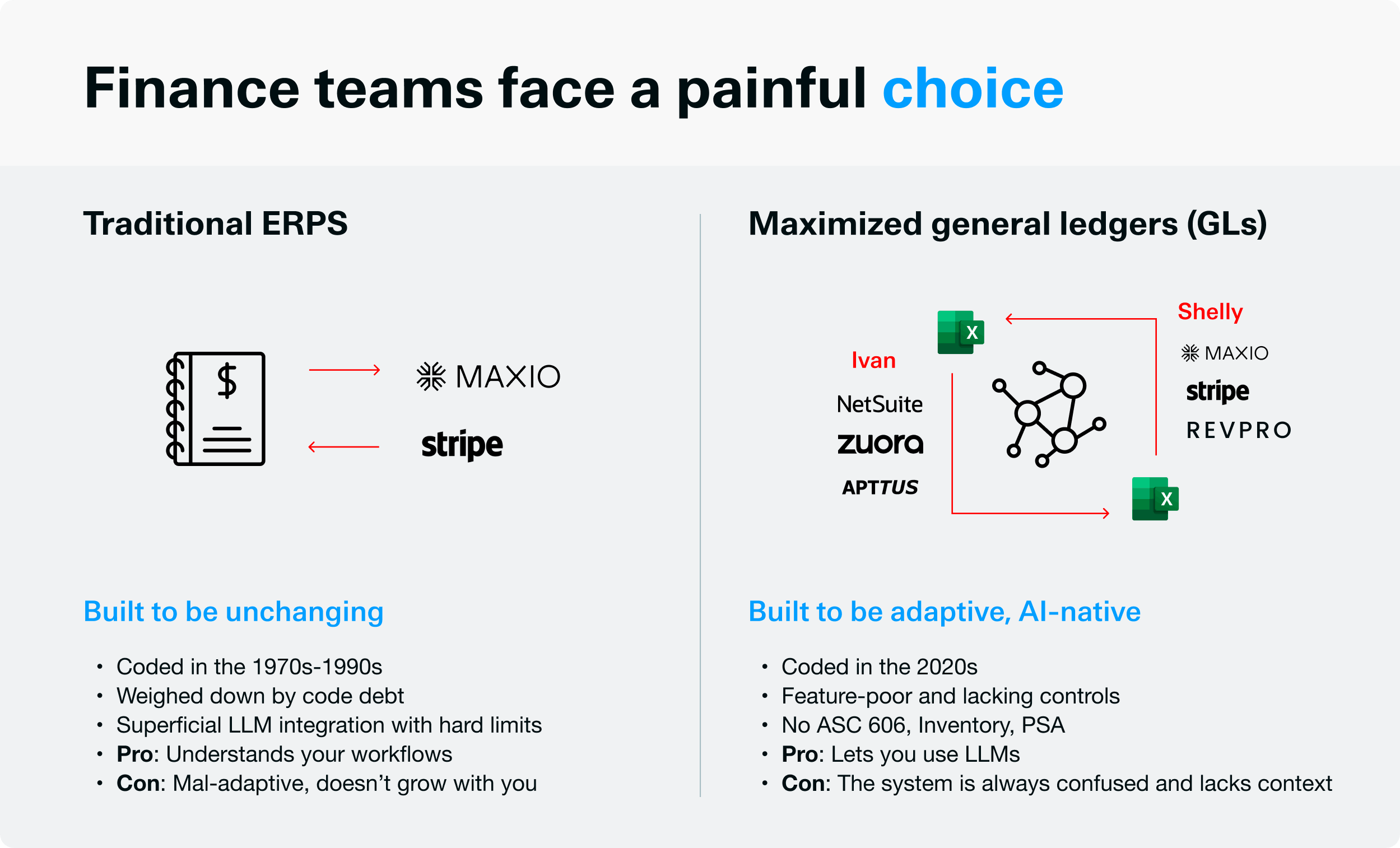
Neither sets these businesses up to be adaptive. One has too many guardrails and no intelligence, the other, intelligence but no guardrails. Neither really understands that today, business is about adapting to change, and the need for a fluid kind of back-office structure that breaks, learns, and improves.
Lensing’s founding team noticed this gap and began gathering, asking, what would it be to start entirely over?
“Lensing began around 2020 in Mountain View, USA, and Heidelberg, Germany, with a conviction shared by a small group of enterprise software veterans that ERP could not be incrementally fixed,” says Stefan Sigg, Enterprise Architect and founding team member. Along the way, they realized that in a time when AI can generate quality code, software engineering isn’t the bottleneck—knowing what you need, and specifying it is. This became our second and perhaps larger product: An app-generation tool we call AiSpecify that allows anyone in the business to build new, production-ready ERP applications such as treasury management or a deal desk without technical support.
This is what places Lensing is in a bit of a category of its own. It’s all the time-tested core ERP functionality you need, with the power to build itself. With agents that complete the task work.
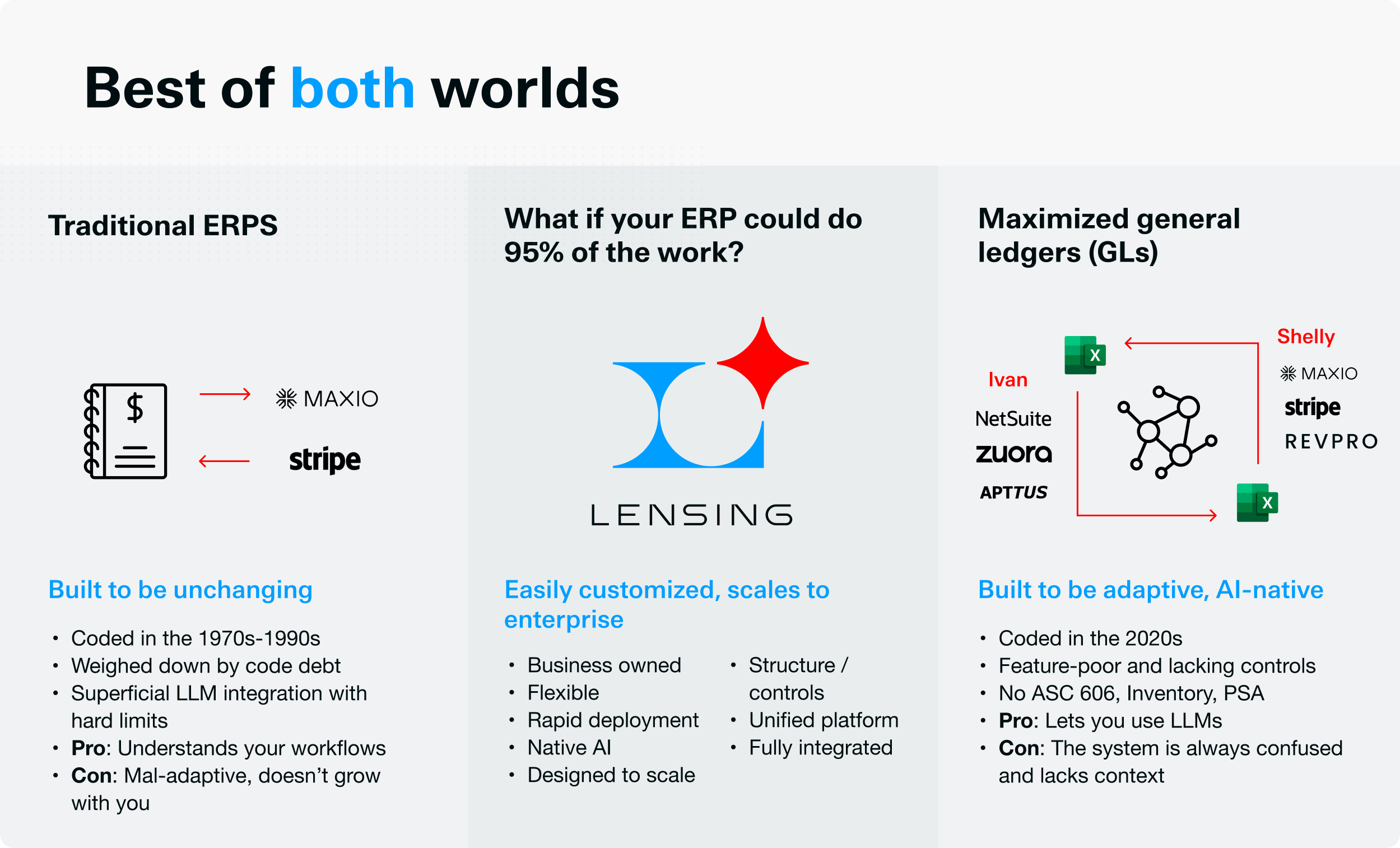
That makes it a tool with the power to align massive forces so precisely that the light around them bends and is drawn into focus—revealing what was always there but previously out of reach.
Which makes Lensing a great name for our next phase of serving our customers.